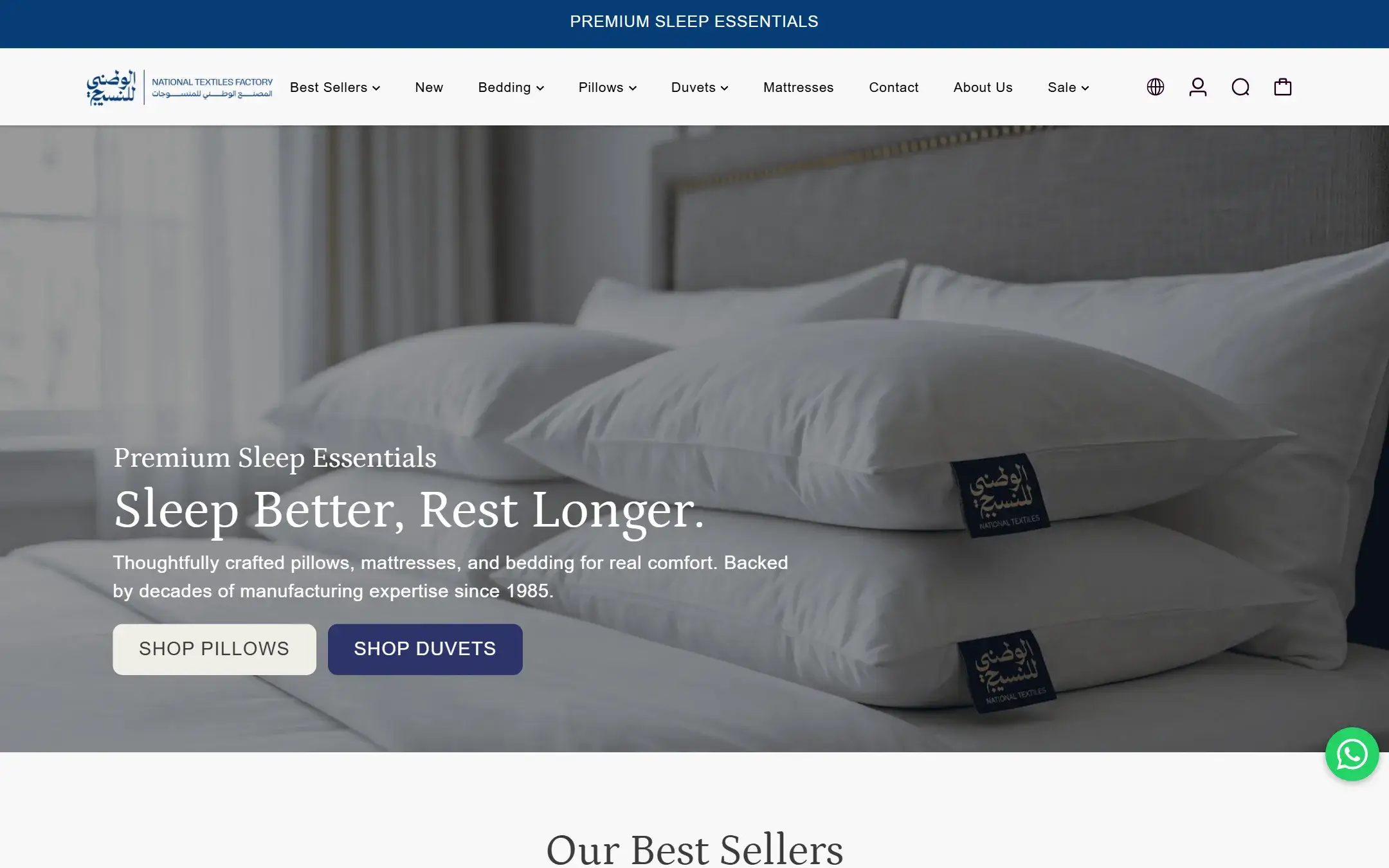
Bedding e-commerce
National Textiles
Qatar manufacturer selling pillows, duvets, mattresses and bedding online since 1985.
E-commerce development
We build online stores that take payments in Qatar, handle local delivery and work in Arabic and English. Your team runs the store every day without calling us.
Vibes offers ecommerce website development in Qatar for businesses that want to sell online properly. We design the store, load your catalogue, connect payments, set up delivery rules and train your team on orders and stock. We are a Doha studio registered with the Qatar Free Zones Authority, FZA No. 268. Since 2021 we have delivered more than 150 projects, and we hold a 5.0 rating from 91 Google reviews.
Our ecommerce work includes the Shopify store for National Textiles, a Qatar bedding manufacturer, and the WooCommerce store for Cabina, a Qatar seller of custom kitchens, vanities and wardrobes. This page explains how we plan an online store in Qatar, which platform fits which business, and what to settle before you launch.
A store is a daily operation, not a brochure. Before any design, we agree five things with you: the platform, the size and structure of the catalogue, how customers pay, how orders get delivered, and who on your team runs the store each day.
These answers decide most of the cost and the timeline. A store with 60 products and simple variants is a different job from a store with thousands of products, trade prices and an ERP link. We write the answers into the scope, so the price and the plan match what you actually sell.
Your customers need to pay by card with confidence. We integrate local and international payment gateways, depending on your business, your bank and where your customers are. The gateways we integrate include Stripe, MyFatoorah, SkipCash, QPay, Sadad, Dibsy, Fatora, Checkout.com, TESS Payments, Tap Payments, Noqoody, and the payment gateways of all Qatar banks.
The gateway account is opened in your company name, with your bank, so the money goes straight to you. Approval can take time and the gateway will ask for your company documents, so we start that conversation early. We then set up the gateway in the store and test real payments, refunds and failed payments end to end before launch.
We also check what the customer sees. The payment page should load fast on a phone, show the right currency and work in Arabic as well as English.
Delivery is where many stores in Qatar lose money or customers. We set up delivery zones for Doha and other areas, with a fee for each zone. You can add a free-delivery threshold, a flat fee, or different fees for heavy or bulky items.
Cash on delivery is your choice. Some customers in Qatar still prefer it, but it adds risk and handling work for your team. We can switch it on for all orders, limit it to some areas or order values, or leave it off. If you use a delivery partner and they offer an integration, we can connect it so orders pass to them directly.
We also set clear delivery times and messages on the product and checkout pages. A customer who knows when the order will arrive is less likely to call or cancel.
An Arabic store is more than translated product names. The whole layout flips. Menus, filters, sliders, the cart and the checkout must all work right to left. Prices, sizes and phone numbers need care, and Arabic fonts need their own sizes to read well on a phone.
We set up both languages from the start, including product pages, checkout, order emails and SMS or WhatsApp messages where the platform allows. Each language has its own URLs, so both can appear in Google. If your product descriptions are only in English, plan who will write the Arabic versions before launch.
Shopify is the fastest route to a reliable store. Hosting, security and updates are handled for you, and there are apps for almost every need. The trade-offs are monthly platform fees, app fees that add up, and less control over checkout and some features. We built the National Textiles store on Shopify.
WooCommerce runs on WordPress. It suits businesses that already use WordPress or want full control of hosting and data. It can be extended in almost any direction. The trade-off is maintenance. Someone must keep WordPress, the plugins and the server updated and secure. We built the Cabina store on WooCommerce.
A custom build makes sense when your pricing, ordering or integrations are too complex for either platform. Examples are B2B ordering with customer-specific prices, product configurators, or deep ERP links. It costs more to build and needs a support plan, but it does exactly what your business needs. We recommend a platform only after we understand your catalogue, your team and your budget.
Launch is the start. Your team adds products, changes prices, manages stock and processes orders and refunds from the store dashboard. We train them on the real store and leave written guides for the common tasks.
We set up Google Analytics, Meta Pixel, discount codes and abandoned cart emails before launch, so you can see what sells and recover lost carts from day one. After launch, a support contract covers updates, backups, fixes and small changes.
Ask to see live stores. Place a test order on your phone, switch to Arabic and look at the checkout. Ask who opens the payment gateway account, who owns the store, and who you call when an order fails on a Friday night.
Ask for the scope in writing, including the number of products loaded, the delivery rules and the payment methods. You can see our live stores for National Textiles and Cabina on the Work page.
What is included
A store designed to sell, with your catalogue, categories, variants and photos loaded and organised.
Card payments through local and international gateways, set up and tested end to end before launch.
Delivery zones and fees for Doha and beyond, cash on delivery if you want it, stock levels and low-stock alerts.
Orders, refunds, customers and invoices managed from one dashboard.
Product pages, checkout and customer emails in both languages, with full right-to-left layout.
Google Analytics, Meta Pixel, discount codes and abandoned cart emails set up before launch.
Clean product URLs, titles, descriptions, structured data and redirects from any old store.
Your team learns to add products, change prices, manage stock and process orders on the real store.
The store account, domain, products and customer data belong to your company.
Factories and brands that want to sell to customers in Qatar without a middleman, like National Textiles.
Shops that want their catalogue online, with ordering, delivery and stock that match the showroom.
Kitchens, furniture and fit-out products where the store takes orders and enquiries, like Cabina.
Stores that have outgrown their current setup and need a migration that keeps products, customers and rankings.
Suppliers that need trade pricing, bulk ordering or ERP links that a standard store cannot handle.
How we work
We agree the platform, catalogue size, payments and delivery, then send a written scope and price.
You approve the home, category, product and checkout pages before we build.
We build the store, connect payments and load your products. You test real orders on staging.
We go live, train your team on orders and stock, and support the store after launch.
Technology
Fast to launch, hosting and security handled, and an app for almost every need.
Full control of hosting and data, and a natural fit for businesses already on WordPress.
For complex pricing, B2B ordering or deep ERP integration that off-the-shelf platforms cannot handle.
Local and international gateways so customers in Qatar can pay by card with confidence.
Shows which products and pages sell, and where shoppers drop out of the checkout.
Tracks sales from Instagram and Facebook so you can see which campaigns bring real orders.
Timeline
Price in QAR
From QAR 25,000
The price depends on the platform, the number of products, the payment and delivery setup and any integrations. A typical range will be shown here, and our website cost guide explains what moves the price.
Final price after a free scoping call.
Read the website cost guide for QatarRelated work
Bedding e-commerce
Qatar manufacturer selling pillows, duvets, mattresses and bedding online since 1985.
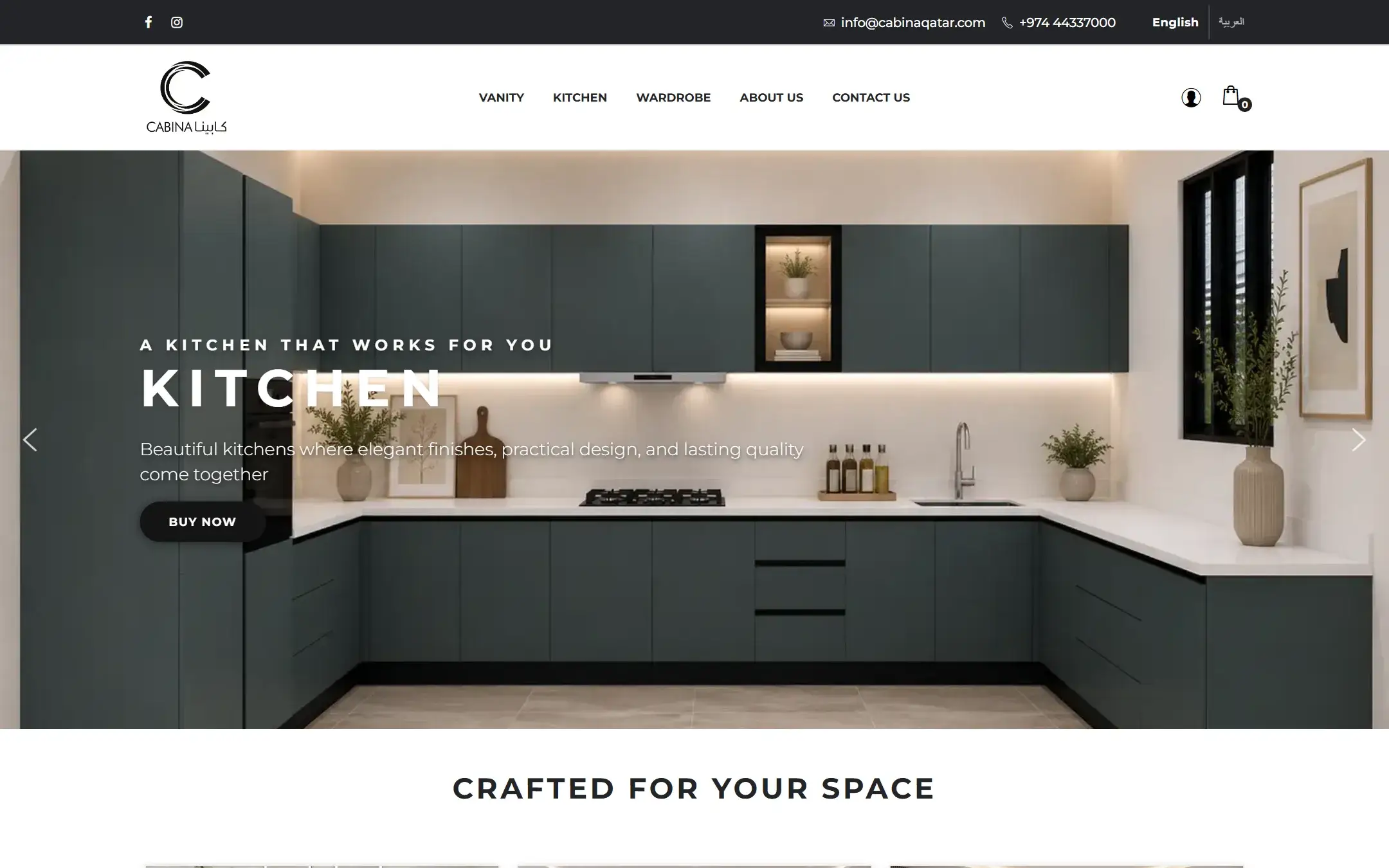
Kitchens e-commerce
Qatar seller of custom kitchens, bathroom vanities and wardrobes, with online ordering.
5.0 rating, 91 reviews on Google. Read the reviews on Google (opens in a new tab)
"Excellent service. Professional, good advice, always on time and available."
"Technically skilled developers with reliable after-sales support."
FAQ
Yes, but your business needs a commercial registration and licence whose activities cover online selling. Licence activities differ, so confirm yours with the Ministry of Commerce and Industry before you launch. We build the store, but we cannot give legal advice or promise approval.
Shopify is faster to launch and needs less maintenance. WooCommerce gives more control and suits businesses already on WordPress. We recommend one after we understand your catalogue, team and budget.
Yes. We integrate local and international payment gateways and test card payments end to end before launch. The gateway account is opened in your company name.
Yes, if you want it. We can turn it on for all orders, limit it to some areas or order values, or leave it off.
Yes. We set delivery zones, fees and free-delivery thresholds, and can connect a delivery partner if they offer an integration.
Yes. Your team adds products, changes prices, manages stock and processes orders from the store dashboard. We train them at handover.
Yes. We migrate products, customers and order history where the platforms allow it, and redirect old product URLs so you keep your Google rankings.
Yes. Product pages, checkout and customer emails work in Arabic and English, with full right-to-left layout.
You do. The store account, domain, products and customer data belong to your company.
iOS and Android apps for customers, staff or field teams, from one codebase.
Learn moreCorporate websites and platforms your team can update without calling us.
Learn moreAn AI assistant that answers your customers on WhatsApp, Instagram and your website, in Arabic and English.
Learn moreHosting, updates, backups and fixes after launch, under an agreed SLA.
Learn moreTypical price ranges by project type, and what drives the cost.
Read the website cost guide for QatarStart a project
Send the form, call, email or WhatsApp. Every channel reaches the same team.